

ActualitésActu18 août 2026
Vieira appointed Senegal coach: the federation has published its objectives, and that's rare
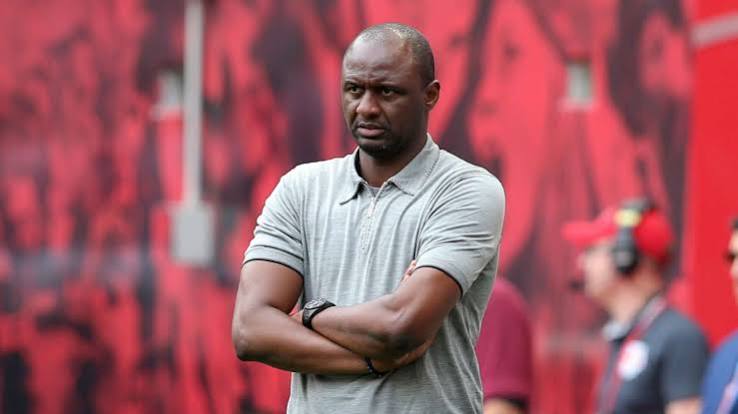
Patrick Vieira is officially the new coach of Senegal. The Senegalese Federation did not just announce it: it made public two quantified objectives, reaching the final of the 2027 AFCON and qualifying for the 2030 World Cup. Few federations agree to be judged on such explicit criteria.
The Official Announcement
The Senegalese national team announced on Tuesday, August 18: "Mr. Patrick Vieira is the new coach of the Senegal A national team. The date of the official presentation and the next steps for his integration will be communicated later."
The appointment was unanimously approved by the emergency committee of the Senegalese Football Federation during an extraordinary session held via videoconference on Monday, August 17.
Vieira succeeds Pape Thiaw, who was dismissed on July 11 after the Lions' elimination in the round of 16 of the 2026 World Cup, against Belgium.
Two Public Objectives, and That's the News
This is what distinguishes this appointment from most others, and what deserves to be highlighted.
The federation has set two explicit objectives for the arrival of its coach: reaching the final of the 2027 Africa Cup of Nations and qualifying Senegal for the 2030 World Cup.
This is unusual. Most federations, in Africa and elsewhere, appoint a coach without ever publicly stating what would constitute success. This imprecision protects them: without announced criteria, no assessment can be contested, and failure can always be reframed as a building phase.
By publishing two measurable objectives, the FSF agrees to be judged on them. This is a risk-taking move, and it deserves to be recognized as such.
Note also the precise wording of the first objective: reaching the final, not winning the AFCON. This is an ambitious but calibrated objective, which does not promise a title. This precision matters for those who will assess the outcome in eighteen months.
What Vieira Has Never Done
The point of caution is the same as what we noted for Xavi in the Netherlands last week.
Patrick Vieira has never been a national team coach. A 1998 World Cup winner and 2000 European champion with France, with 107 caps, he has coached at club level – but managing a national team is a different job.
A national team coach does not recruit, does not work daily with his players, and has a few training camps per year to instill a playing style. He manages players he almost never sees, spread across clubs that have different priorities than his own. Recognized club coaches have struggled in this role, and effective national team coaches have failed at club level.
His experience as a top international player is a real asset for credibility within the locker room. It guarantees nothing in terms of methodology.
Two African Federations, Two Opposite Choices
A comparison is necessary, and we make it without ranking.
On August 13, we wrote that the Netherlands had hired Xavi after being eliminated from the World Cup by Morocco – and that Morocco, for its part, had dismissed Xavi to maintain its confidence in Mohamed Ouahbi, a national technician.
Senegal is doing the opposite. Eliminated in the round of 16, it parts ways with its Senegalese coach and appoints a former French international who has never managed a national team.
Both decisions are defensible and respond to different logics. Continuity with a local coach relies on field knowledge and stability. Recruiting an international name relies on top-level experience and the ability to impose immediate authority.
We have no reason to say which is the right one, and no one will know for several years. We simply note that two major African federations have made opposite decisions within a few days of each other, which contradicts the idea of a single model.
What's Still Missing
The date of the official presentation is not known. The contract duration has not been communicated, nor his salary, nor the composition of his staff.
These are precisely the elements that will allow us to judge the solidity of the project. A coach appointed until the 2027 AFCON and a coach appointed until 2030 do not work in the same way, and the stated objective for the 2030 World Cup suggests a long-term horizon – without the federation having yet confirmed it.
We will wait for the official presentation rather than extrapolate.
Sources: Senegalese Football Federation, France 24, Foot Mercato. As of August 18, 2026.